Understanding America in the giant company’s shadowBy Vauhini Vara
This article was published online on February 12, 2021.
In the mid-1990s, when I was in middle school, my family moved to the suburbs of Seattle, where my father had gotten a job at Boeing. My parents would drive my sister and me down I-90 to the Bellevue Square mall on weekends, and I’d sit on the carpet of the B. Dalton bookstore, reading magazines. A mile and a half up Bellevue Way, in the garage of a rented house, Jeff Bezos was starting Amazon. For some time, Amazon’s influence was little noticed. In high school, the drive to my part-time job took me through what was then the nondescript South Lake Union neighborhood—dotted with auto shops, warehouses, and, along the waterfront, a few marinas. The main landmark was Denny Triangle’s Elephant Car Wash, with its pair of pink, elephant-shaped neon signs. It was a perfect specimen of the kitsch for which Seattle was known at the time, and I loved it.
Only recently has the South Lake Union area that I remember been transformed by the sprawling landscape of Amazon’s campus, which includes a Harry Potter–themed library, a dog deck featuring a fake fire hydrant, and three enormous, spherical plant conservatories. This past October, the Denny Triangle Elephant Car Wash closed down, under pressure from the pandemic and rising taxes and rent. Its owner donated one of the elephant signs to Amazon. “They asked for it, they wanted to have it,” Bob Haney told The Seattle Times. “So I gifted it to them.”
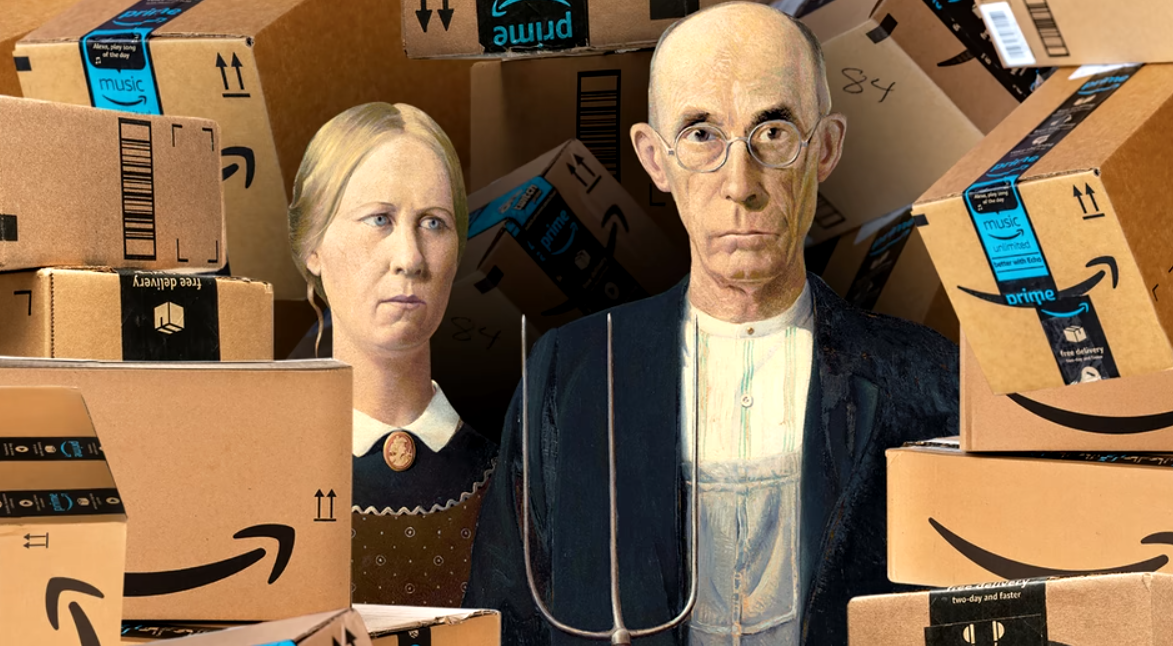
Haney isn’t a character in Fulfillment: Winning and Losing in One-Click America, Alec MacGillis’s wide-ranging, impressionistic tour of a nation whose citizens’ existence has become intertwined with a single corporation, but he easily could have been. Plenty of books have been written about Amazon, so MacGillis wasn’t interested in probing the inner workings of the corporation itself. Instead, he set out to explore “the America that fell in the company’s lengthening shadow”—that is, the places where Amazon’s influence has undermined social cohesion in pervasive ways. Finding such places turns out to be easy.
There are countless ways to measure Amazon’s hold on American life. More people in the U.S. subscribe to its Prime service than voted for either Donald Trump or Joe Biden in the past election: more than 100 million, by recent estimates. Amazon reaps fully half of what people in this country spend online. It is the second-biggest private workplace in the United States, after Walmart, employing more than 800,000 people, most of whom will never set foot in the Seattle headquarters’ plant spheres. Among Amazon’s large Arizona-based workforce, most of it inside warehouses, one in three people was on the federal Supplemental Nutrition Assistance Program in 2017. Incidentally, Amazon, along with Walmart, has been one of the biggest beneficiaries of an arrangement that allows food stamps to be used for online groceries, bringing in large amounts of government money. Bezos, Amazon’s CEO, is the richest person alive.